
SLAP Tear Types on MRI: Snyder Classification I-IV
Understand SLAP tear types I-IV on shoulder MRI, including superior labrum fraying, biceps anchor detachment, bucket-handle tears, biceps tendon extension, and treatment implications.
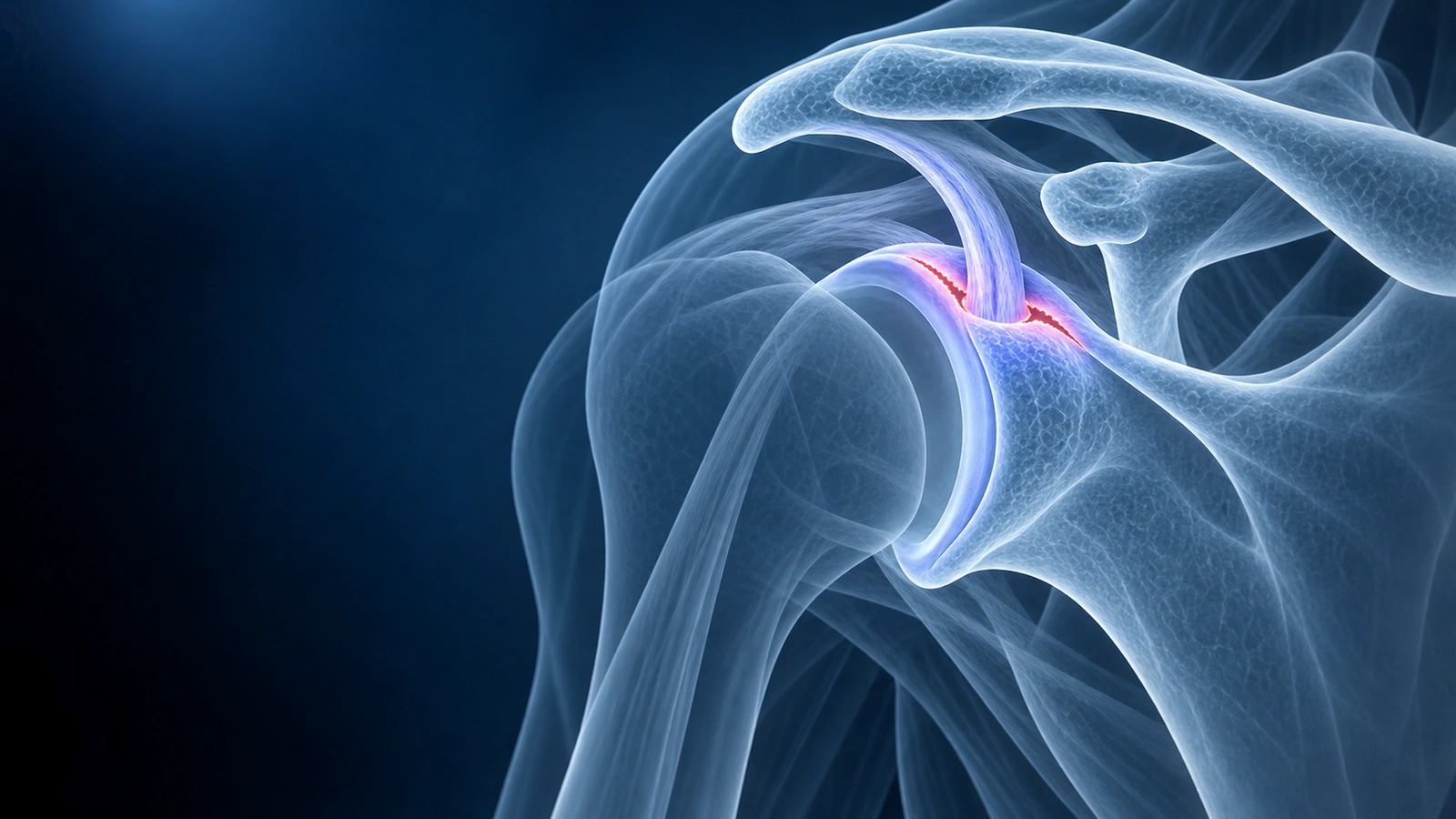
A SLAP tear — Superior Labrum Anterior to Posterior — is a lesion of the top portion of the glenoid labrum that runs from in front of the biceps anchor to behind it. The superior labrum serves as the attachment point for the long head of the biceps tendon, so SLAP injuries often involve the biceps anchor to varying degrees depending on tear type.
This guide is about classification and treatment expectations. If you are trying to understand whether your scan shows a labral tear at all, start with the shoulder labral tear MRI signs page, then return here to separate SLAP type I, II, III, and IV patterns.
SLAP tears occur through several mechanisms: a fall on an outstretched arm (FOOSH), repetitive overhead throwing motions in athletes such as baseball pitchers or swimmers, traction injuries from a sudden shoulder pull, and degenerative wear in older patients. Stephen Snyder introduced the original four-type classification in 1990, providing a framework that directly guides arthroscopic treatment decisions. Understanding these types helps you interpret your MRI report and discuss surgical options with your orthopedic surgeon.
Type I: Fraying
Type I is the mildest form and is largely degenerative in nature. The superior labrum shows fraying and degeneration of its inner free edge, but the labrum itself remains firmly attached to the glenoid rim and the biceps anchor is completely intact. The labrum does not peel away from the bone. Type I lesions are most common in older patients and are often incidental findings on shoulder MRI obtained for other reasons. Because the biceps anchor is secure and the labrum is attached, Type I injuries rarely cause the mechanical symptoms seen with higher-grade SLAP tears.
Treatment is arthroscopic debridement to smooth the frayed tissue. No repair is required, and outcomes are generally good. Recovery is faster than for types requiring formal repair.
Type II: Detachment of Biceps Anchor
Type II is the most common SLAP tear, accounting for approximately 55% of all SLAP lesions. The superior labrum and the biceps anchor are detached from the superior glenoid rim — the labrum peels away from the bone, creating instability of the biceps anchor. This detachment is the key distinction from Type I. Patients typically report pain with overhead activities, a painful click or pop, and in throwing athletes, a loss of velocity and accuracy with a characteristic "dead arm" feeling.
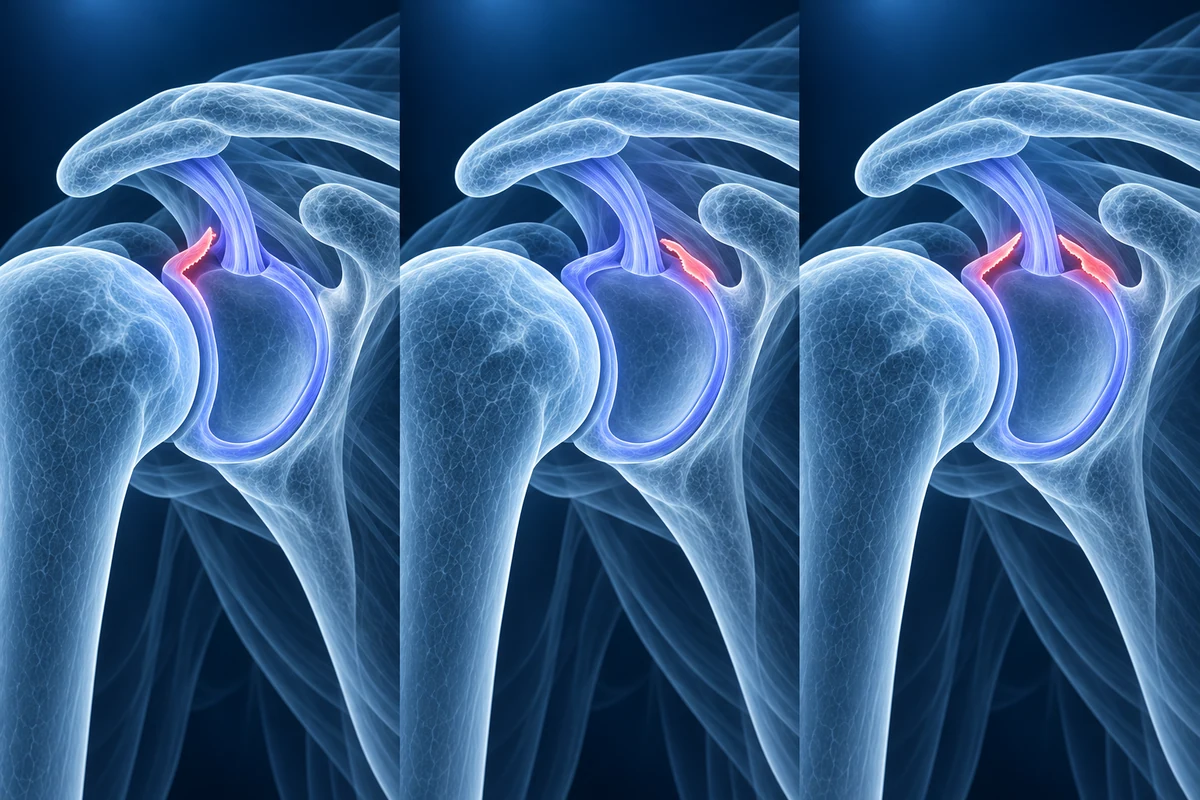
Snyder further subdivided Type II into three subtypes. Subtype A (anterior) involves detachment anterior to the biceps anchor. Subtype B (posterior) involves detachment posterior to the biceps anchor and is the subtype most commonly associated with the peel-back mechanism in overhead throwing athletes. Subtype C (combined) involves detachment both anterior and posterior. Subtype B and C are associated with greater functional loss in throwing athletes.
Treatment for Type II SLAP tears in younger, active patients or overhead athletes is arthroscopic repair with suture anchors to reattach the labrum and biceps anchor to the glenoid rim. In older patients (typically over 35-40 years) or those with concurrent biceps pathology, biceps tenodesis — detaching the biceps tendon from the labrum and reattaching it lower on the humerus — may produce better outcomes than labral repair alone.
Type III: Bucket-Handle Tear with Intact Biceps Anchor
Type III involves a bucket-handle tear of the superior labrum — the torn portion of the labrum displaces into the joint like the handle of a bucket — but the biceps anchor remains firmly attached to the glenoid. This is an important distinction from Type IV. The displaced bucket-handle fragment can cause mechanical symptoms including clicking, locking, and catching during shoulder motion. Because the biceps anchor is intact, shoulder stability is better preserved than in Type II.
Treatment is arthroscopic debridement to resect the unstable bucket-handle fragment. Because the biceps anchor remains attached, formal labral repair with anchors is generally not required. Recovery is typically faster than for Type II repairs.
Type IV: Bucket-Handle Tear Extending into Biceps Tendon
Type IV is the most complex Snyder type. Like Type III, a bucket-handle tear of the superior labrum is present, but in Type IV the tear extends up into the biceps tendon itself. The degree of biceps tendon involvement is variable — from a small split to involvement of more than 50% of the tendon width. When the biceps tendon split is significant, it compromises biceps function and stability. For guidance on interpreting labral and biceps findings on MRI, see our article on how to read shoulder MRI.
Treatment depends on the extent of biceps tendon involvement. When less than 30-50% of the tendon is split, the bucket-handle fragment and split portion are debrided and the remaining labrum is repaired with suture anchors. When more than 50% of the biceps tendon is involved, biceps tenodesis combined with labral debridement is typically preferred over attempted repair, because the tendon quality is insufficient to reliably heal. See our overview of shoulder labral tears for a broader clinical context.
MRI Findings Across Types
Conventional MRI has a sensitivity of approximately 50-80% for SLAP tears, limited by the complex anatomy and small size of the superior labrum. MR arthrography — intra-articular injection of gadolinium contrast followed by MRI — improves sensitivity to approximately 90% by distending the joint and highlighting labral detachments and intra-substance splits. MR arthrography is the preferred study when SLAP tear is clinically suspected.
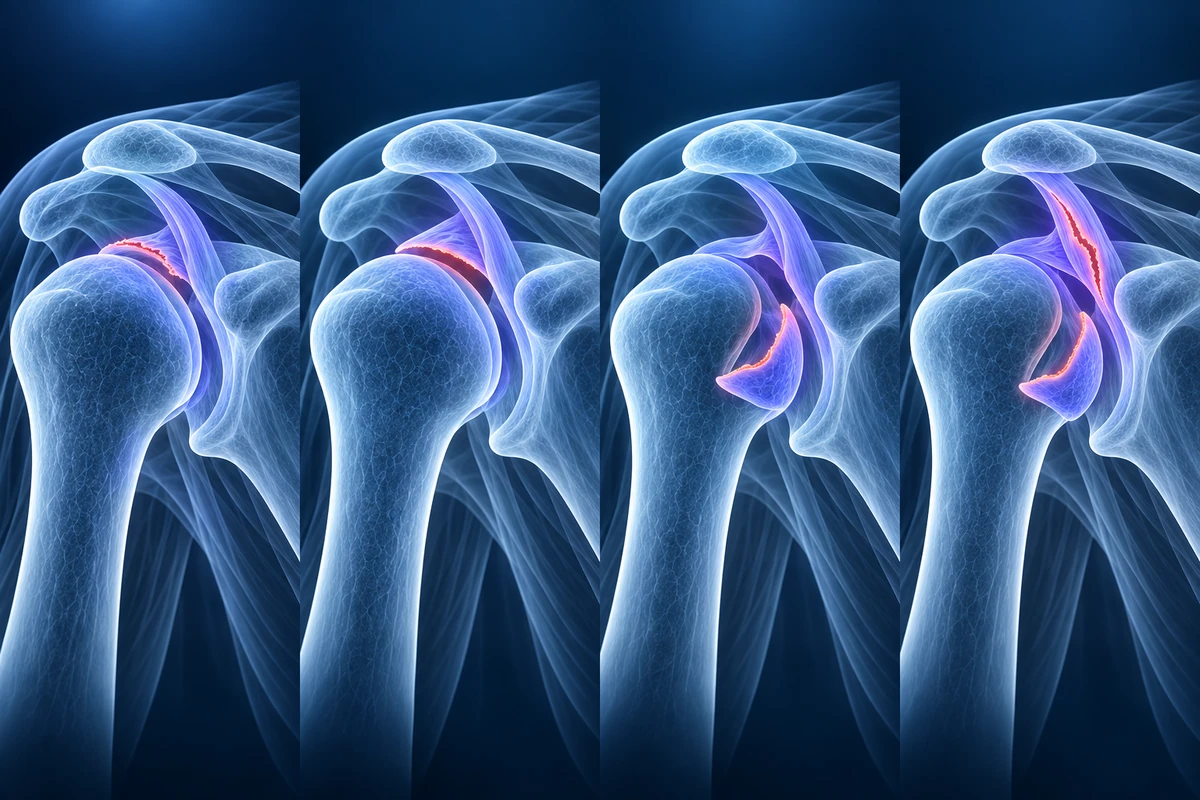
On MRI, Type I tears show irregular fraying of the superior labral edge without detachment. Type II tears show a high-signal line (fluid or gadolinium) undercutting the superior labrum at the labro-chondral junction, with the labrum lifting away from the glenoid — this linear signal is the key finding. Type III tears show a displaced bucket-handle fragment projecting into the joint on coronal images, with the base labrum still attached. Type IV tears additionally show fluid or gadolinium extending into a split within the biceps tendon on axial images. The O'Brien active compression test is the most commonly used clinical screen for SLAP tears, though no single clinical test has adequate sensitivity to replace imaging.
Treatment by Type
Type I and Type III tears are treated with arthroscopic debridement of the unstable or frayed tissue. Because the biceps anchor is intact in both types, formal reattachment with suture anchors is not required, leading to faster recovery.
Type II tears require reattachment of the detached labrum and biceps anchor to the superior glenoid. In younger overhead athletes, arthroscopic labral repair with suture anchors is standard. In patients over 35-40, in those with concurrent long head biceps tendinopathy, or in those who are not overhead athletes, biceps tenodesis consistently produces equivalent or superior patient-reported outcomes compared with labral repair, with a lower reoperation rate.
Type IV treatment depends on the proportion of biceps tendon involvement. Minor splits (under 30-50%) are debrided and the remaining labrum is repaired. Major splits (over 50%) are managed with biceps tenodesis plus labral debridement. Tenodesis eliminates the pain generator while preserving biceps function with minimal cosmetic deformity compared with tenotomy.
Key Takeaways
- SLAP = Superior Labrum Anterior to Posterior; all four Snyder types involve the superior labrum at the biceps anchor
- Type I (fraying, intact anchor) and Type III (bucket-handle, intact anchor) are treated with debridement only
- Type II (detached biceps anchor) is the most common type (~55%) and requires repair or biceps tenodesis depending on patient age and activity
- Type IV (bucket-handle extending into biceps tendon) treatment depends on the percentage of tendon split — over 50% involvement favors tenodesis over repair
- MR arthrography (intra-articular gadolinium) achieves ~90% sensitivity for SLAP tears vs ~50-80% for conventional MRI
- Biceps tenodesis is increasingly preferred over labral repair for Type II SLAP in patients over 35-40 or those with concurrent biceps pathology
Frequently Asked Questions
Why is MR arthrography used instead of regular MRI for SLAP tears?
Conventional MRI has a sensitivity of only 50-80% for SLAP tears because the superior labrum is small and complex in shape. MR arthrography involves injecting dilute gadolinium contrast directly into the shoulder joint before the scan. The distension separates the labrum from the glenoid and highlights even small detachments or labral splits as bright fluid signal on fat-suppressed T1 images. This improves sensitivity to approximately 90%, making it the preferred study when SLAP tear is clinically suspected.
What is the difference between a SLAP tear and a Bankart tear?
Both are labral tears, but they occur at different locations around the glenoid rim. A SLAP tear affects the superior labrum (12 o'clock position) at and around the biceps anchor. A Bankart lesion affects the anteroinferior labrum (5-6 o'clock position) and is caused by anterior shoulder dislocation. Bankart tears are the most common cause of recurrent anterior instability, while SLAP tears are more commonly associated with overhead athlete symptoms and biceps-related pain.
Can a SLAP tear heal without surgery?
Type I tears often do not require surgery and can be managed with physical therapy focused on rotator cuff strengthening and scapular stabilization. However, Type II tears with a detached biceps anchor have limited intrinsic healing capacity because the detached tissue cannot re-adhere to bone without mechanical stabilization. Conservative management for Type II may reduce pain but does not restore the anatomical attachment. Surgery is generally recommended for younger active patients with Type II-IV tears who fail a 3-6 month trial of physical therapy.
Does a clicking or popping sound in the shoulder mean I have a SLAP tear?
Not necessarily. Clicking and popping in the shoulder can arise from many sources, including rotator cuff impingement, biceps tendon subluxation, acromioclavicular joint pathology, and normal ligament snapping. SLAP-related clicks are typically painful and felt deep inside the joint, often reproduced with overhead elevation or external rotation under load. The O'Brien active compression test and other SLAP-specific provocation tests help differentiate, but MR arthrography is required for definitive imaging diagnosis.
When can a throwing athlete return to sport after SLAP repair?
Return to throwing after Type II SLAP repair typically takes 6-9 months, and full competitive return for overhead athletes is often 9-12 months. The extended timeline reflects the biological time required for the repaired labrum to reattach to bone and mature. Interval throwing programs begin at approximately 4-5 months post-operatively when range of motion and rotator cuff strength are restored. Return-to-sport rates after SLAP repair in overhead athletes range from 63-83% in the literature, with some patients electing tenodesis after failed repair to improve outcomes.
Related Articles
Understand your shoulder MRI report, key anatomical structures, and what common findings mean.
Bankart and Hill-Sachs lesions on shoulder MRI — anterior shoulder dislocation pattern, on-track vs off-track concept, glenoid bone loss, and recurrence risk.
Related Conditions
Ready to analyze your imaging? Upload your MRI or X-ray for AI-powered analysis
Upload your MRI or X-ray DICOM files for private, AI-powered analysis. 4 models analyze independently — raw scan files stay in your browser.
Start AnalysisMedical Disclaimer: This page is for informational and educational purposes only. It does not constitute medical advice, diagnosis, or treatment. AI-generated analysis may contain errors. Always consult a qualified healthcare professional for medical decisions. Full Disclaimer