
Common Symptoms
- Sudden severe shoulder pain, often waking the patient at night
- Pain with overhead activity and a painful arc between 60 and 120 degrees
- Sleep disturbance caused by positional pain, especially lying on the affected side
- Preceding period of gradual aching followed by an acute crystal-like pain episode
- Tenderness over the greater tuberosity at the supraspinatus insertion
- Reduced active range of motion during the acute phase with near-normal passive motion
Calcific Tendinitis on MRI: AI-Powered Imaging Analysis
AI-powered calcific tendinitis (rotator cuff calcification) imaging analysis on shoulder MRI and X-ray. Gärtner classification, formative vs resorptive phases, and what the findings mean.
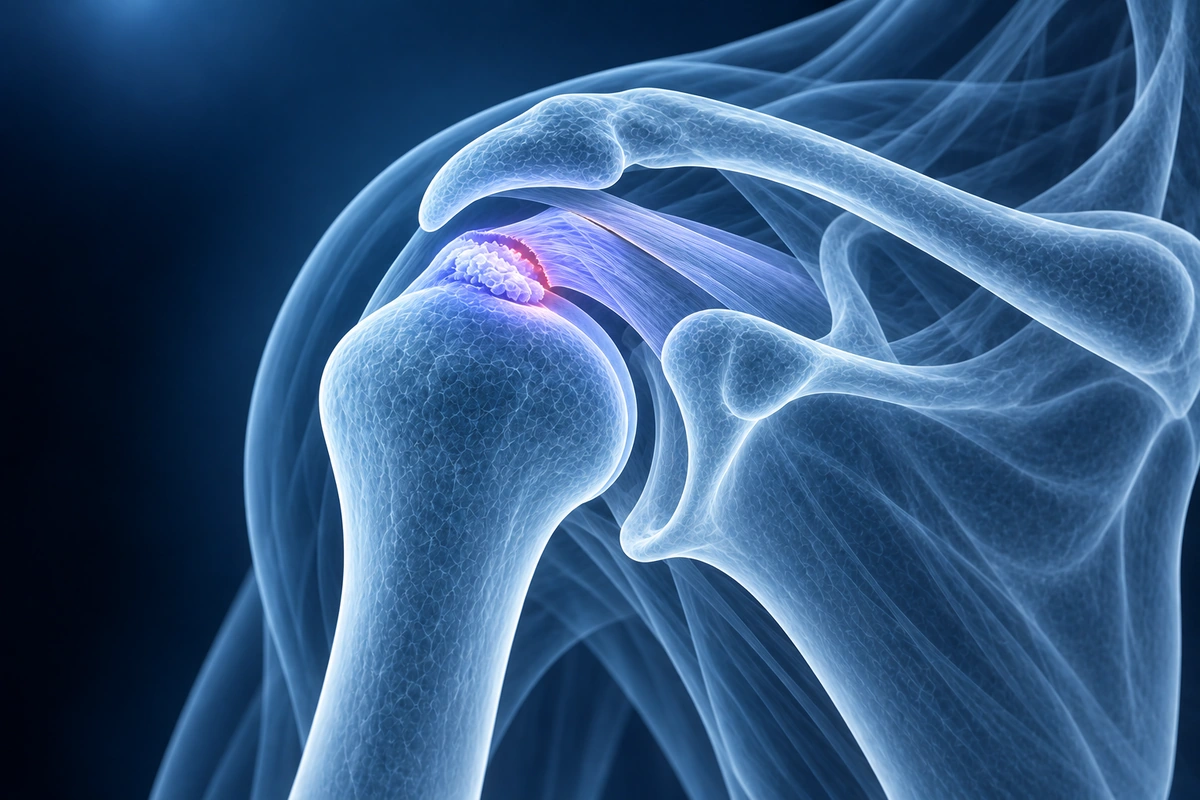
Calcific tendinitis of the shoulder is the deposition of calcium hydroxyapatite crystals within the rotator cuff tendons, most commonly in the supraspinatus at the critical zone near the greater tuberosity insertion. The condition is more common than many patients expect, affecting approximately 3% of the general adult population. It passes through distinct phases: a formative (chronic) phase during which calcium deposits slowly accumulate with minimal symptoms, and a resorptive phase during which the body actively breaks down and absorbs the calcium. It is the resorptive phase that produces the characteristic severe, acute, crystal-like pain — paradoxically, the more inflamed the tissue is, the closer the body is to resolving the deposit spontaneously.
Calcific tendinitis is usually self-limiting over a course of months to years. Many deposits resolve completely without intervention. However, in the acute resorptive phase the pain can be severe enough to warrant treatment. Our AI consortium assesses both X-ray and MRI to characterise the deposit type, phase, and relationship to the subacromial space and bursa.
What We Look For on Imaging
- Focal calcium deposit within the supraspinatus tendon on X-ray, typically at the critical zone 1–2 cm proximal to the greater tuberosity
- T2 hypointense (dark) focus within the tendon on MRI with surrounding high-signal edema in the resorptive phase, indicating active inflammation
- Intact tendon fibers surrounding the deposit — distinguishing calcific tendinitis from a concurrent rotator cuff tear
- Subacromial bursal extension of the deposit when calcium ruptures through the tendon surface, often the moment of peak acute pain
- Gärtner classification on X-ray: Type A (dense, homogeneous, well-defined) — formative; Type B (dense, inhomogeneous); Type C (transparent, fluffy, poorly defined) — resorptive
- Assessment for pseudo-paralysis or associated partial rotator cuff tearing when the clinical presentation is severe
Frequently Asked Questions
Does calcific tendinitis require surgery?
Most cases resolve without surgery. The majority of patients improve with a combination of rest during the acute phase, non-steroidal anti-inflammatory drugs, physiotherapy to maintain range of motion and strengthen surrounding muscles, and a subacromial corticosteroid injection to reduce bursal inflammation. Ultrasound-guided barbotage (needle lavage) is a minimally invasive procedure that can accelerate resolution in persistent or severely symptomatic deposits, particularly Gärtner Type C resorptive lesions. Arthroscopic removal is reserved for deposits that fail to resolve after 6-12 months of conservative management and barbotage. Even large deposits frequently resorb spontaneously over 12-18 months, so early surgery is rarely justified.
What is barbotage and how does it work?
Barbotage (also called ultrasound-guided percutaneous needle aspiration and lavage) is a procedure performed under real-time ultrasound guidance in which one or two needles are inserted directly into the calcium deposit. Saline is repeatedly injected and aspirated to break up, lavage, and partially aspirate the calcific material. When the deposit is in the resorptive phase (soft, paste-like consistency), a significant portion of the calcium can be aspirated through the needle. Needle lavage accelerates resorption and provides rapid pain relief in many patients, with studies showing improvement in 60-80% of appropriately selected cases. A corticosteroid injection into the subacromial bursa is usually given at the end of the procedure to reduce post- procedure flare.
How is calcific tendinitis different from a rotator cuff tear?
Both conditions cause shoulder pain and can reduce range of motion, but they have different imaging appearances and treatment paths. Calcific tendinitis shows a focal calcium deposit within an otherwise intact tendon; the pain is typically episodic and acute during the resorptive phase, and most cases resolve without surgery. A rotator cuff tear shows disruption or thinning of the tendon fibers — partial or full thickness — without a calcific deposit (unless both are present simultaneously, which does occur). Cuff tear pain is often more persistent, activity-related, and associated with weakness. MRI reliably distinguishes the two: the dark, dense calcium focus of calcific tendinitis is quite different from the fluid-filled gap of a cuff tear on T2 sequences.
Related Articles
Upload your imaging to check for Calcific Tendinitis
Upload your MRI or X-ray DICOM files for private, AI-powered analysis. 4 models analyze independently — raw scan files stay in your browser.
Upload & AnalyzeMedical Disclaimer: This page is for informational and educational purposes only. It does not constitute medical advice, diagnosis, or treatment. AI-generated analysis may contain errors. Always consult a qualified healthcare professional for medical decisions. Full Disclaimer